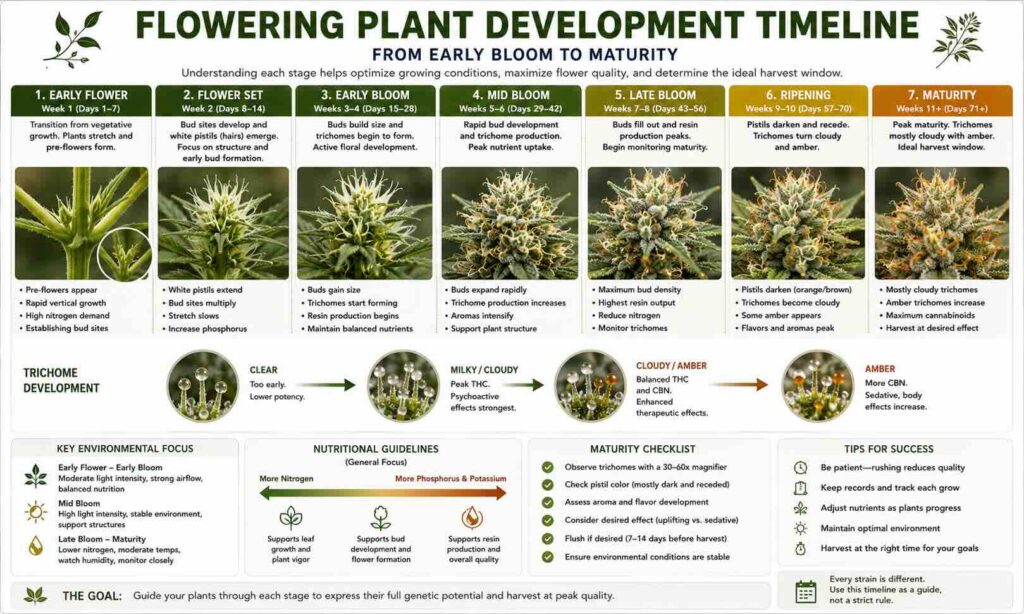
The flowering stage is one of the most important phases in the cannabis life cycle. During this period, plants shift their energy from vegetative growth toward reproductive development, leading to the formation and maturation of flowers. For growers, understanding the different flowering stages helps improve cultivation management, environmental control, and overall plant observation.
Although flowering is often discussed as a single phase, it is actually a progression of several stages. Each stage brings visible changes in plant structure and development. Recognizing these transitions allows growers to better understand plant behavior and make informed cultivation decisions throughout the growing cycle.
The Transition Into Flowering
The flowering process begins when a plant receives the signals necessary to move beyond vegetative growth. In photoperiod cultivars, this transition is influenced by changes in light exposure, while autoflowering genetics enter flowering automatically based on age.
During this early stage, plants often experience noticeable growth as they adapt to their new developmental phase. Branches continue extending, and the overall structure of the plant becomes more defined.
This transition period is important because it establishes the foundation for later flower development.
Careful observation during this phase helps growers understand how individual plants respond to changing conditions.
Early Flower Development
As flowering progresses, plants begin producing visible flower sites. These structures gradually develop throughout the canopy, marking the beginning of reproductive growth.
Environmental consistency becomes especially important during this stage. Lighting, airflow, temperature, and humidity all contribute to maintaining stable growing conditions as flowers continue developing.
Many growers focus on monitoring plant health and canopy structure during early flowering to ensure that environmental conditions remain balanced.
Strong development during this stage helps support later flower formation.
Mid-Flowering Growth
The middle portion of the flowering cycle is characterized by continued flower expansion and increasing plant maturity. At this stage, plants devote significant energy toward reproductive development while maintaining overall health and vigor.
Canopy management and environmental monitoring remain important throughout this period. Consistent conditions help plants continue developing in a predictable manner and make it easier for growers to evaluate progress.
Because plants may display different growth patterns depending on their genetics, observation remains an important cultivation skill.
Each cultivar expresses its characteristics in a unique way throughout flowering.
Late Flowering and Maturation
As flowering approaches its final stages, plants continue maturing and refining their reproductive structures. Growth typically becomes less focused on expansion and more focused on completing development.
Many growers pay close attention to plant appearance and overall health during this phase. Stable environmental conditions remain important because significant fluctuations can create unnecessary stress late in the growing cycle.
Growers interested in exploring modern autoflowering genetics can learn more through https://www.ministryofcannabis.com/fr/graines-autofloraison/.
Understanding the maturation process helps cultivators develop greater confidence in managing flowering plants.
The Importance of Observation Throughout Flowering
One of the most valuable skills during flowering is observation. Every cultivation environment presents unique conditions, and plants may respond differently depending on genetics, environmental management, and cultivation practices.
Keeping records throughout the flowering cycle allows growers to compare results across multiple grows and identify opportunities for improvement. Over time, this information becomes a valuable resource for refining cultivation techniques.
Additional information regarding cannabis research and educational topics can be explored through https://theconversation.com/fr/topics/cannabis-1510.
Continuous learning remains one of the most important aspects of successful cannabis cultivation.
Final Thoughts
Understanding cannabis flowering stages helps growers better interpret plant development and manage cultivation environments more effectively. From the initial transition into flowering through final maturation, each stage plays an important role in the life cycle of the plant.
By observing plants carefully, maintaining stable environmental conditions, and learning from each growing cycle, cultivators can build valuable experience and develop a deeper appreciation for the complexity of cannabis cultivation.